

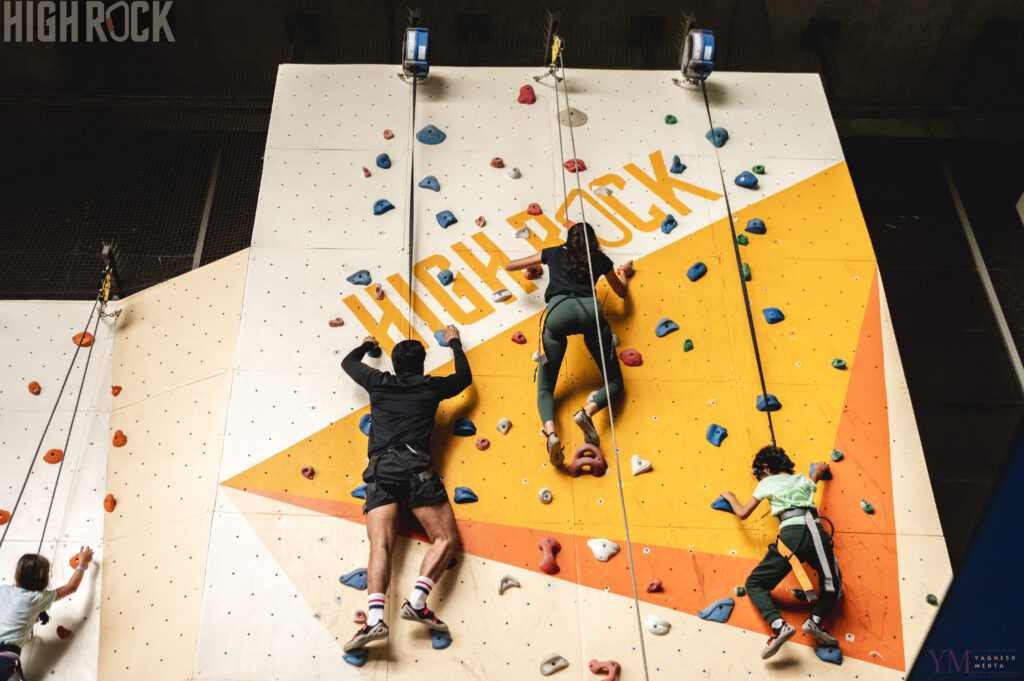
Indoor Climbing
The Reach. The Relief. The Reward.
Climbing for Everyone
No prior experience. No “pro” strength required.
At High Rock, we make climbing accessible from the very first step. Our team guides you with simple, jargon-free instructions, and all equipment is provided – so you can focus on the climb, not the setup.
The Vertical Flow
Climbing naturally brings your focus into the present.
As you move from hold to hold, your attention sharpens, your breathing settles, and everything else fades into the background. It’s a full-body workout with a mental reset built in.
The Recovery Ritual
Go beyond the climb with our signature Ice Bath Reset.
Our guided ice bath sessions help calm the nervous system, reduce fatigue, and support faster recovery – leaving you refreshed, recharged, and ready to go again.
Complete Support
From your first knot to your final high-five, you’re supported throughout.
Our mentors are always on hand to guide, encourage, and ensure a safe, enjoyable experience – whether you’re climbing for the first time or building a routine.
Frequently Asked Questions
About Indoor Climbing
Is indoor climbing hard for beginners? + -
It feels challenging the first time, but that's part of the appeal. The beginner routes at High Rock are designed to be achievable, and most first-timers complete multiple routes in their first session. The difficulty is what makes the progress satisfying.
How is indoor climbing different from outdoor climbing? + -
Indoor climbing takes place on artificial walls with manufactured holds in a controlled environment. Outdoor climbing is on natural rock with variable surfaces and conditions. Indoor climbing is the standard entry point for outdoor climbers and an excellent training tool, but it's also a fully standalone sport in its own right.
Do I need a partner to go indoor climbing? + -
Not at High Rock. Our auto-belay stations allow you to climb solo. Bouldering also requires no partner. If you want to top rope with a lead belay, you'll either need a partner or arrange an instructor-led session.
How often should I climb to see improvement? + -
Two to three sessions per week is the sweet spot for most climbers, seeing consistent improvement. One session per week will still yield gradual progress. More than four sessions per week may outpace your tendons' capacity to recover, especially in the early months.
Is indoor climbing good for weight loss? + -
It's an effective calorie-burning activity; 500 to 700 calories per 2-hour session is a realistic range. More usefully, it builds lean muscle mass and improves metabolic rate in ways that compound over time. Most regular climbers notice body composition changes within 6 to 8 weeks.
What is the difference between bouldering and top rope climbing? + -
Top rope uses a rope and harness with a belayer; on taller walls, it's more endurance-focused and more accessible for first-timers. Bouldering uses no rope, on shorter walls over crash pads, it's more power and technique-focused. Both are available at High Rock, and most climbers do both.
Can I bring children for indoor climbing? + -
Yes. High Rock is family-friendly, and children's sessions are available. For structured learning, our Academy for Kids & Adults is the recommended starting point for younger climbers.
Is indoor climbing hard for beginners?
It feels challenging the first time, but that’s part of the appeal. The beginner routes at High Rock are designed to be achievable, and most first-timers complete multiple routes in their first session. The difficulty is what makes the progress satisfying.
How is indoor climbing different from outdoor climbing?
Indoor climbing takes place on artificial walls with manufactured holds in a controlled environment. Outdoor climbing is on natural rock with variable surfaces and conditions. Indoor climbing is the standard entry point for outdoor climbers and an excellent training tool, but it’s also a fully standalone sport in its own right.
Do I need a partner to go indoor climbing?
Not at High Rock. Our auto-belay stations allow you to climb solo. Bouldering also requires no partner. If you want to top rope with a lead belay, you’ll either need a partner or arrange an instructor-led session.
How often should I climb to see improvement?
Two to three sessions per week is the sweet spot for most climbers, seeing consistent improvement. One session per week will still yield gradual progress. More than four sessions per week may outpace your tendons’ capacity to recover, especially in the early months.
Is indoor climbing good for weight loss?
It’s an effective calorie-burning activity; 500 to 700 calories per 2-hour session is a realistic range. More usefully, it builds lean muscle mass and improves metabolic rate in ways that compound over time. Most regular climbers notice body composition changes within 6 to 8 weeks.
What is the difference between bouldering and top rope climbing?
Top rope uses a rope and harness with a belayer; on taller walls, it’s more endurance-focused and more accessible for first-timers. Bouldering uses no rope, on shorter walls over crash pads, it’s more power and technique-focused. Both are available at High Rock, and most climbers do both.
Can I bring children for indoor climbing?
Yes. High Rock is family-friendly, and children’s sessions are available. For structured learning, our Academy for Kids & Adults is the recommended starting point for younger climbers.