

Not an Adventure Sport. An Olympic One. Here’s the Difference.
Rethinking What Climbing Actually Is
For a lot of people, the word climbing brings up a very specific image.
Cliffs. Harnesses. Risk.
Something extreme. Something not meant for everyone. And that’s usually where the hesitation begins.
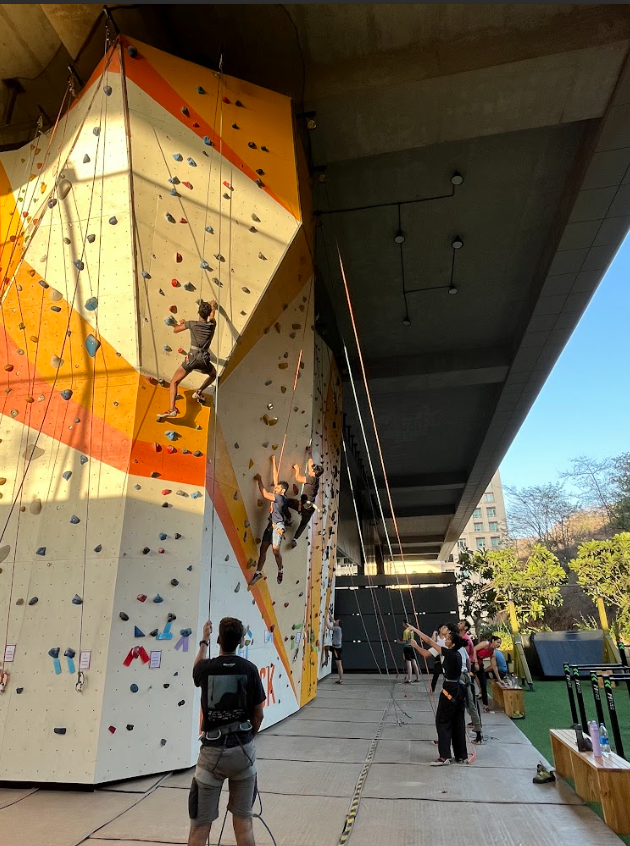
But step into an indoor climbing space, and the experience feels very different from that mental picture. What you see is structure. Routes mapped out in advance. Movements that have been thought through. People attempting, sending, learning— all within a system that’s been carefully designed.
It starts to look less like an “adventure” and more like a sport.
Because that’s exactly what it is. Indoor climbing – now on the Olympic stage, judged, standardised – is built around precision, control, and technique. The focus isn’t solely on thrill. It’s on movement, problem-solving, and progression.
Built by Experts, Not Left to Chance
A big part of that difference comes from how indoor climbing spaces are actually created.
Every route on the wall is designed by trained setters – often with national and international experience – who understand movement at a deep level. They’re not just placing holds randomly. They’re building sequences that guide how your body moves, how difficulty progresses, and how safely a climb can be attempted.
That’s why climbs feel intuitive even when they’re challenging. There’s intent behind every hold, every reach, every step. Alongside that, the equipment itself meets global standards.
From the holds on the wall to the mats below, everything is built for durability, grip, and impact absorption. The flooring is specifically designed to handle repeated falls. The surfaces are maintained to ensure consistency. It’s the kind of setup you see across serious climbing facilities worldwide.
What Safety Actually Looks Like Here
The first question most people have is still the same: is it safe?
The answer becomes clearer the moment you spend time at the facility.
At High Rock, floor marshals are always present; watching, guiding when needed, stepping in before something becomes an issue. It creates an environment where you can focus on climbing, knowing someone is always keeping an eye out.
All of this works together to create something that feels controlled, even when it’s physically demanding.
What feels unfamiliar at first becomes predictable. And with that predictability comes confidence.
Why More People Are Trying It
As more people look for indoor activities in Mumbai that feel engaging, climbing has started to stand out.
It holds your attention in a way most workouts don’t. There’s always something new to try, a different route to figure out, a slightly better way to move.
It also feels accessible.
There’s no fixed starting point. People ease into it at their own pace, building comfort as they go. Some come in for fitness, some for a change of routine, some out of curiosity – and many end up staying because it feels good to return to.
What Changes Once You Experience It
The perception shift happens gradually.
What once felt intimidating starts to feel structured. What seemed unpredictable begins to feel thought-through. And the label of “adventure sport” starts to lose its meaning.
Indoor climbing is designed, tested, and refined – by experts, with the right systems in place, and with safety built into every layer of the experience.
Which is why it doesn’t feel like something extreme once you’re in it.
It feels like something you can keep coming back to, getting better at, and enjoying along the way.
And that’s the difference.
One session is usually all it takes to change your mind.
Leave a Reply